Bringing Light to Families Displaced in South Sudan
Bringing Light to Families Displaced in South Sudan In early March 2026, extreme violence in Abiemnhom County devastated entire communities,

Published June 1, 2026 · Updated August 6, 2026
In honor of this year’s UNESCO International Day of Light, Unite to Light hosted the inaugural Illuminating Impact Symposium, centered around the annual theme: Light and Sustainability. The symposium brought together leaders in clean energy, healthcare, technology, policy, philanthropy, and humanitarian impact to explore how light-driven innovation can create a more sustainable and equitable future.
Hosted at the Institute for Energy Efficiency at University of California, Santa Barbara, the event provided a fitting setting for conversations around the transformative power of light, energy efficiency, and global sustainability. Throughout the day, attendees engaged with an inspiring lineup of keynote speakers, moderators, panelists, and impact partners whose expertise spanned industries and continents.
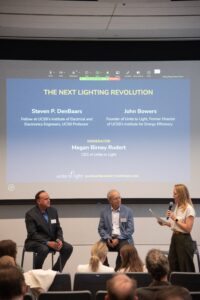
The symposium opened with keynote remarks moderated by Megan Birney Rudert, director of Unite to Light, featuring distinguished speakers Steven DenBaars Director of UCSB’s Institute for Energy Efficiency and John Bowers, founder of Unite to Light and former IEE director. Their discussion highlighted the extraordinary role that light-based technologies play in advancing sustainability, improving quality of life, and driving innovation across sectors.
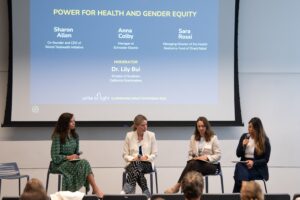
The symposium’s first panel, moderated by Dr. Lily Bui of Southern California Grantmakers, explored the intersection of health, gender equity, and access to light. Panelists included Sharon Allen from the World Telehealth Initiative, Sara Rossi from Direct Relief, and Anna Coby from Schneider Electric.
The conversation highlighted the importance of expanding access to reliable light and energy resources worldwide, particularly for women and healthcare workers in underserved communities. Panelists discussed how dependable lighting can directly improve maternal healthcare outcomes, especially for midwives and frontline health workers assisting births in low-resource settings.
Sharon Allen spoke about the critical role reliable power plays in delivering healthcare through telemedicine. She shared the story of a pregnant patient who was able to connect remotely with physicians through telehealth services. During the consultation, doctors recommended additional testing that uncovered a life-threatening condition, allowing the patient to receive treatment before the situation became critical. Access to consistent electricity was essential in making that connection possible and ultimately played a role in saving the patient’s life.
The discussion underscored the broader importance of sustainable energy access in strengthening healthcare systems and advancing gender equity around the world. From telehealth consultations to maternal care, reliable power enables healthcare providers to deliver critical services when and where they are needed most.
Dr. Bui guided the conversation with thoughtful and compelling questions, while panelists shared valuable insights from their respective organizations and industries, highlighting both the challenges and opportunities that exist in expanding access to healthcare and energy worldwide.
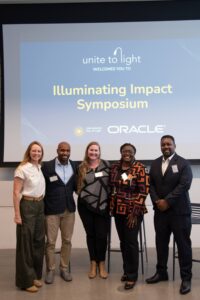
Throughout the symposium, Unite to Light also highlighted the work of several extraordinary impact partners who are advancing sustainability, humanitarian aid, healthcare access, and community resilience around the world.
Featured impact partners included the United Nations Population Fund (UNFPA), Olasimbo Sojinrin of Solar Sister, Akon Mugabwe of Winko Solar, Henry Red Cloud of Red Cloud Renewable, Marco Sanchez of World Central Kitchen, Josh Cox of Community Power South, and Cassie Roach of the Safe Parking Program.
Together, these organizations shared powerful examples of how access to sustainable lighting and renewable energy can transform lives, from supporting maternal healthcare and disaster relief efforts to strengthening Indigenous communities and assisting individuals experiencing housing insecurity.
Josh Cox discussed the importance of accessible energy infrastructure in New Orleans and the role it plays in responding to disasters and power outages. He highlighted the deployment of neighborhood resilience centers- community gathering spaces equipped with rooftop solar and battery storage systems that can continue providing power when the grid goes down. These centers serve as critical resources for residents during emergencies and extreme weather events.
Olasimbo Sojinrin spoke about the importance of designing programs with communities rather than for them. Drawing on Solar Sister’s work, she emphasized the need to ensure that women in last-mile communities are included in decision-making processes and program design so that solutions reflect their realities, priorities, and needs.
Akon Mugabwe shared a particularly moving story about a young girl who lost her life after a hospital power outage caused her oxygen machine to stop functioning. He explained how experiences like these drive Winko Solar’s mission to develop modular, scalable solar and battery storage systems that help hospitals maintain reliable power for critical medical equipment, even when the electrical grid fails.
These stories served as powerful reminders that access to energy is about far more than electricity alone. Reliable power can mean access to healthcare, disaster resilience, economic opportunity, and, in some cases, the difference between life and death. Their participation reinforced one of the symposium’s central themes: that sustainable light and energy solutions are not just technological innovations, but tools for dignity, safety, opportunity, and resilience.
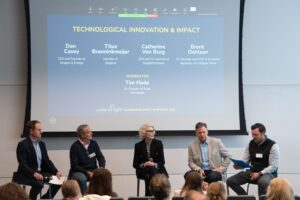
Following a networking break, the symposium continued with the panel Local Innovation, Global Impact, moderated by Tim Hade. The panel featured Dan Casey of Dragon Q Energy, Catherine Von Burg of SimpliPhi Power, Brent Dehlsen representing Clipper, Ecomerit, and Aquantis, and Titus Brenninkmeijer of Solgenix and the Energy Access Fund.
The discussion focused on the challenges and opportunities involved in scaling innovative companies from local startups into organizations with global impact. Catherine Von Burg spoke passionately about building businesses that prioritize both profitability and social responsibility, emphasizing that employees at her company shared ownership so they could feel personally invested in the company’s mission and success. Her comments reinforced the idea that for-profit companies can still create meaningful positive impact.
Audience questions sparked an engaging conversation about artificial intelligence and sustainability within the renewable energy industry. Panelists discussed how AI can help optimize clean energy systems and improve efficiency, while also acknowledging the growing responsibility of technology companies to ensure that the energy demands of AI do not undermine broader sustainability goals.
Of particular interest to the audience was the juxtaposition of Ms. Von Burg, who had successfully exited a battery storage company, and Mr. Casey who is trying to build a battery storage company. All of the participants had insightful advice on raising funds from a variety of sources: from friends and family, to governments and grants, as well as ensuring investments had positive impacts.
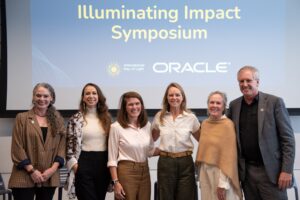 The symposium concluded with a forward-looking discussion on California’s role as a leader in clean energy policy and sustainability. Moderated by Sigrid Wright of the Community Environmental Council, the panel featured David Hochschild, Chair of the California Energy Commission; Christina Snider-Ashtari, Tribal Affairs Secretary in the Office of Governor Gavin Newsom; Alelia Parenteau from the City of Santa Barbara; and Bernadette Del Chiaro of Environmental Working Group.
Panelists explored both the successes and ongoing challenges facing California’s clean energy transition. Christina Snider-Ashtari spoke about the significance of the formal apology extended by the Governor’s Office to California tribes for historic trauma and highlighted the importance of including Native and Indigenous communities in policymaking processes. Her remarks underscored how equitable sustainability efforts must include historically underrepresented voices.
Bernadette Del Chiaro emphasized the importance of expanding rooftop solar access and bringing renewable energy solutions directly into the homes of everyday Californians. David Hochschild discussed California’s national leadership in solar adoption and renewable energy innovation, while also acknowledging the continued work needed to ensure affordability, resilience, and long-term sustainability.
Together, the panel demonstrated how collaboration between policymakers, community leaders, businesses, and advocates will be essential in shaping a cleaner and more equitable energy future.
The inaugural Illuminating Impact Symposium demonstrated the extraordinary potential that emerges when innovators, policymakers, nonprofit leaders, researchers, and community advocates come together around a shared mission. From healthcare and gender equity to clean energy policy and global humanitarian partnerships, each conversation reinforced the same message: light is far more than illumination — it is a catalyst for sustainability, opportunity, and human connection.
Unite to Light is deeply grateful to all of the speakers, moderators, impact partners, sponsors, volunteers, and attendees who made this event possible. Together, we are helping illuminate a more sustainable and equitable future.
We would like to give a special shout out to Oracle Foundation, our Presenting Sponsor, and the Institute for Energy Efficiency, our host for the event.
To see photos of the event, click here. Videos of the panels and speakers can be found on our YouTube Channel here.
If you are interested in helping form next year’s International Day of Light Symposium, contact Megan@unitetolight.org
Bringing Light to Families Displaced in South Sudan In early March 2026, extreme violence in Abiemnhom County devastated entire communities,
From Santa Barbara to the Mountains of Honduras: Helping the Helpers Last year, we celebrated the International Day of Light
Lighting Recovery: A Disaster Response Partnership in Hawaii When severe flooding swept across Oahu in Spring 2026, hundreds of families